Table of Contents
The Upfront Cost Challenge
A solar system can significantly reduce dependence on grid electricity, but the biggest barrier for many homeowners is the upfront installation cost.
Instead of paying the entire amount at once, eligible homeowners may finance the installation through a solar loan and pay it through monthly EMIs.
Depending on the system cost, electricity consumption, subsidy, tariff, and loan terms, the monthly solar savings may offset a significant portion of the EMI. In this guide, we break down exactly how solar financing in Meerut and Western Uttar Pradesh works.
How Solar Loan + Subsidy Works
Getting a solar loan isn't entirely separate from the installation process—they run parallel. Here is the complete process:
- Choose capacity: Finalize the required solar capacity based on your electricity bill.
- Get a quotation: Receive a quotation from an eligible/empanelled vendor like Kailash Solar.
- Apply for subsidy: Apply through the National Portal for PM Surya Ghar.
- Apply for financing: Apply for an eligible solar loan through a bank or via the Jan Samarth portal.
- Installation: Complete installation and all DISCOM/net-metering requirements.
- Verification: The installation undergoes joint inspection and a commissioning report is generated.
- Subsidy processing: Eligible subsidy/CFA is processed according to the scheme rules.
Important Note: Subsidy eligibility, approval, and disbursement are subject to government rules and the applicable process. In some financing arrangements, the subsidy may subsequently be credited or adjusted against the loan account, or transferred according to the bank's internal process.
PM Surya Ghar Subsidy Calculation
To understand your loan amount, you must first understand the subsidy. For eligible residential consumers, the central PM Surya Ghar Muft Bijli Yojana provides:
- 1 kW → ₹30,000 central subsidy
- 2 kW → ₹60,000 central subsidy
- 3 kW → ₹78,000 central subsidy
- Above 3 kW → central subsidy remains capped at ₹78,000
Additionally, the Uttar Pradesh government (UPNEDA) offers an additional state subsidy of ₹15,000 per kW up to 2 kW (maximum ₹30,000) for eligible households.
Therefore, an eligible UP household installing a 3kW or larger system can potentially receive:
• Central subsidy: ₹78,000
• UP additional subsidy: ₹30,000
Total potential benefit: ₹1,08,000
*Note: Eligibility conditions apply. This is exclusively for residential consumers. Subsidy rules can change, and this subsidy is not a guaranteed upfront discount from a vendor's quotation. Commercial and industrial systems do not receive this residential subsidy.
Important: Don't Misunderstand the ₹1,08,000 Subsidy
₹1,08,000 is a maximum potential combined subsidy figure for an eligible residential consumer in Uttar Pradesh under the applicable central and state subsidy structure. It is not a universal cash discount available to every solar buyer. The subsidy requires government approval, proper net-metering installation, and verification before disbursement.
SBI Surya Ghar Loan for Solar Rooftop
The State Bank of India offers a dedicated residential rooftop solar financing product.
- Loan Amount: Up to ₹6 lakh.
- System Capacity: For systems up to 10 kW.
- Tenure: Repayment period up to 120 months (10 years).
- Interest Rate: Generally starting around 5.75% for loans up to ₹2 lakh, and around 7.90% for larger amounts.
- Application: Applications can be routed through the Jan Samarth portal.
- Margin: Margin/down-payment requirements and co-borrower rules apply based on the specific loan amount.
*Interest rates, eligibility, loan amount, margin, and other terms are subject to the bank's current policy and applicant profile.
PNB Rooftop Solar Loan
Punjab National Bank also provides robust financing options for residential rooftop systems under the PM Surya Ghar scheme.
- Loan Amount: Up to ₹2 lakh for systems up to 3 kW, and up to ₹6 lakh for systems above 3 kW (up to 10 kW).
- Tenure: Maximum tenure of 10 years.
- Margin: Typically a 10% margin is required for loans up to ₹2 lakh, and 20% for loans exceeding ₹2 lakh.
- Interest Rate: Generally floating rates starting in the range of 6.5% to 9.25%, depending on the amount and borrower profile.
- Application: Jan Samarth application route is supported.
*Final approval, exact interest rates, CIBIL, and income requirements depend on the bank's assessment at the time of application.
SBI vs PNB: A Quick Comparison
| Feature | SBI Surya Ghar | PNB Rooftop Solar Loan |
|---|---|---|
| Maximum Loan | Up to ₹6 lakh | Up to ₹6 lakh |
| Maximum Tenure | 120 months (10 years) | 10 years |
| Application Route | Jan Samarth / Branch | Jan Samarth / Branch |
Which option is suitable depends on your loan amount, CIBIL profile, income, existing relationship with the bank, and the bank's current terms.
3kW Solar System EMI Example
Let's look at a realistic, illustrative example for a 3kW system.
3kW Cost Breakdown
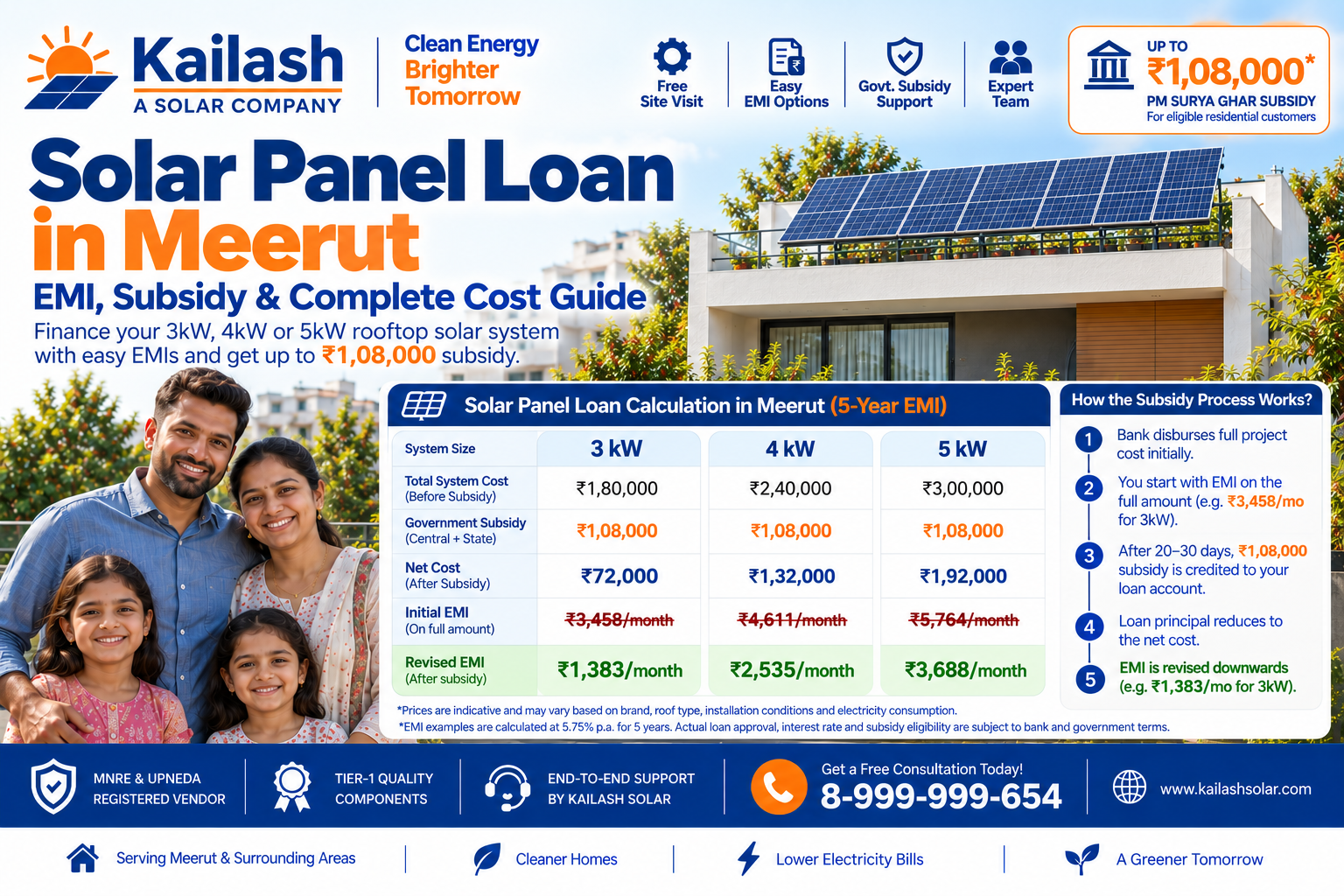
- Illustrative System Price ₹1,80,000
- Eligible Subsidy (Max) -₹1,08,000
- Net Loan Amount ₹72,000
How the EMI Actually Works (at 5.75%)
Banks usually disburse the full project cost initially. When your subsidy arrives (usually in 20-30 days), it gets deposited into the loan account, and your EMI drops.
Illustrative EMI — actual EMI depends on sanctioned loan amount, interest rate, tenure, margin, and bank charges.
4kW Solar System EMI Example
For a 4kW system, remember that the central subsidy remains capped at ₹78,000. For eligible UP consumers, adding the state subsidy (capped at ₹30,000) brings the maximum potential subsidy to ₹1,08,000.
4kW Cost Breakdown
- Illustrative System Price ₹2,40,000
- Eligible Subsidy (Max) -₹1,08,000
- Net Loan Amount ₹1,32,000
How the EMI Actually Works (at 5.75%)
5kW Solar System EMI Example
5kW Cost Breakdown
- Illustrative System Price ₹3,00,000
- Eligible Subsidy (Max) -₹1,08,000
- Net Loan Amount ₹1,92,000
How the EMI Actually Works (at 5.75%)
6kW and Larger Systems
As system sizes increase to 6kW, 8kW, or 10kW, the economics change. It is critical to understand that beyond 3kW, the central residential subsidy is capped at ₹78,000. UP state subsidy is also capped based on applicable rules. Therefore, for larger systems, a higher percentage of the total cost will need to be financed or paid upfront.
EMI vs Electricity Bill: The Real Comparison
Should you finance? Consider this scenario:
Current electricity bill: ₹4,000/month (Annual: ₹48,000)
Illustrative Solar loan EMI: ₹3,500/month (Annual: ₹42,000)
Potential electricity savings: Drastic reduction in utility grid charges.
However, you should not simply compare the EMI with today's electricity bill. The correct comparison should consider: expected solar generation, electricity tariff inflation, self-consumption, net metering export rules, degradation, maintenance, loan interest, and loan tenure.
For some households, the expected monthly electricity savings can be comparable to or greater than the EMI, depending on system size, consumption, and financing terms. But remember: electricity tariffs tend to rise over a 10-year period, whereas your loan EMI remains fixed.
Why Financing Can Make Solar Easier
- Lower upfront burden: You don't need to empty your savings.
- Predictable payments: Fixed monthly EMIs are easier to budget.
- Flexibility: A 5-year loan results in a higher EMI but lower total interest. A 10-year loan gives a lower EMI but higher total interest over time. Homeowners can choose a balance that fits their cash flow.
Example Summary: 3kW vs 4kW vs 5kW
| Metric | 3 kW | 4 kW | 5 kW |
|---|---|---|---|
| Typical Use | 1-2 ACs | 2-3 ACs | 3+ ACs |
| Max Subsidy | ₹1,08,000 | ₹1,08,000 | ₹1,08,000 |
| Example EMI (5 Yrs)* | ₹1,383 | ₹2,535 | ₹3,688 |
*Estimated generation and pricing. Actual output depends on irradiation, roof orientation, shading, inverter performance, and weather in Meerut/Western UP.
Documents Required for a Solar Loan
Typical documentation includes: Aadhaar/KYC, PAN (where applicable), latest electricity bill, property/ownership documents, income documents (ITR/Form 16/Bank statements), and the technical solar quotation from your vendor. Exact documentation depends on the bank and loan amount.
Who Should Consider a Solar Loan?
Financing makes sense for homeowners who have a high electricity bill, plan to stay in their property for several years, have suitable rooftop space, and want to avoid a large upfront payment while utilizing subsidy benefits. Those with ready capital might prefer paying upfront to avoid interest charges entirely.
How Kailash Solar Helps
As an established solar company in Meerut, Kailash Solar does more than just install panels. We guide our customers through the entire journey: from initial system sizing and a transparent quotation, to PM Surya Ghar subsidy guidance, net-metering assistance, and directing you toward financing options.
Want to know whether a 3kW, 4kW or 5kW solar system makes sense for your home? Book a free solar site visit with Kailash Solar and get a personalised quotation based on your electricity consumption, roof area and solar requirements.
Calculate Your True Solar Cost
Book a free site survey. We'll analyze your bill and explain the exact subsidies and loan options available for your Meerut home.
Frequently Asked Questions
Last updated: September 2026. Disclaimer: The interest rates, loan terms, subsidies, and system prices mentioned are illustrative and based on official information available at the time of writing. Always verify current terms with your chosen bank and official government portals.